 Jeepedia

4.0 L AMC / PowerTech (242)
The straight-six that made the Cherokee a legend
If one engine explains why the Cherokee XJ is still sought after and treasured, it's this one: the 4.0-liter inline-six. Derived from AMC's old 258 (4.2 L), it debuted in 1987 and earned a reputation for being indestructible through torque, simplicity and mileage. Plenty of owners talk about engines sailing past 300,000 miles on basic maintenance.
Architecture: proper old iron
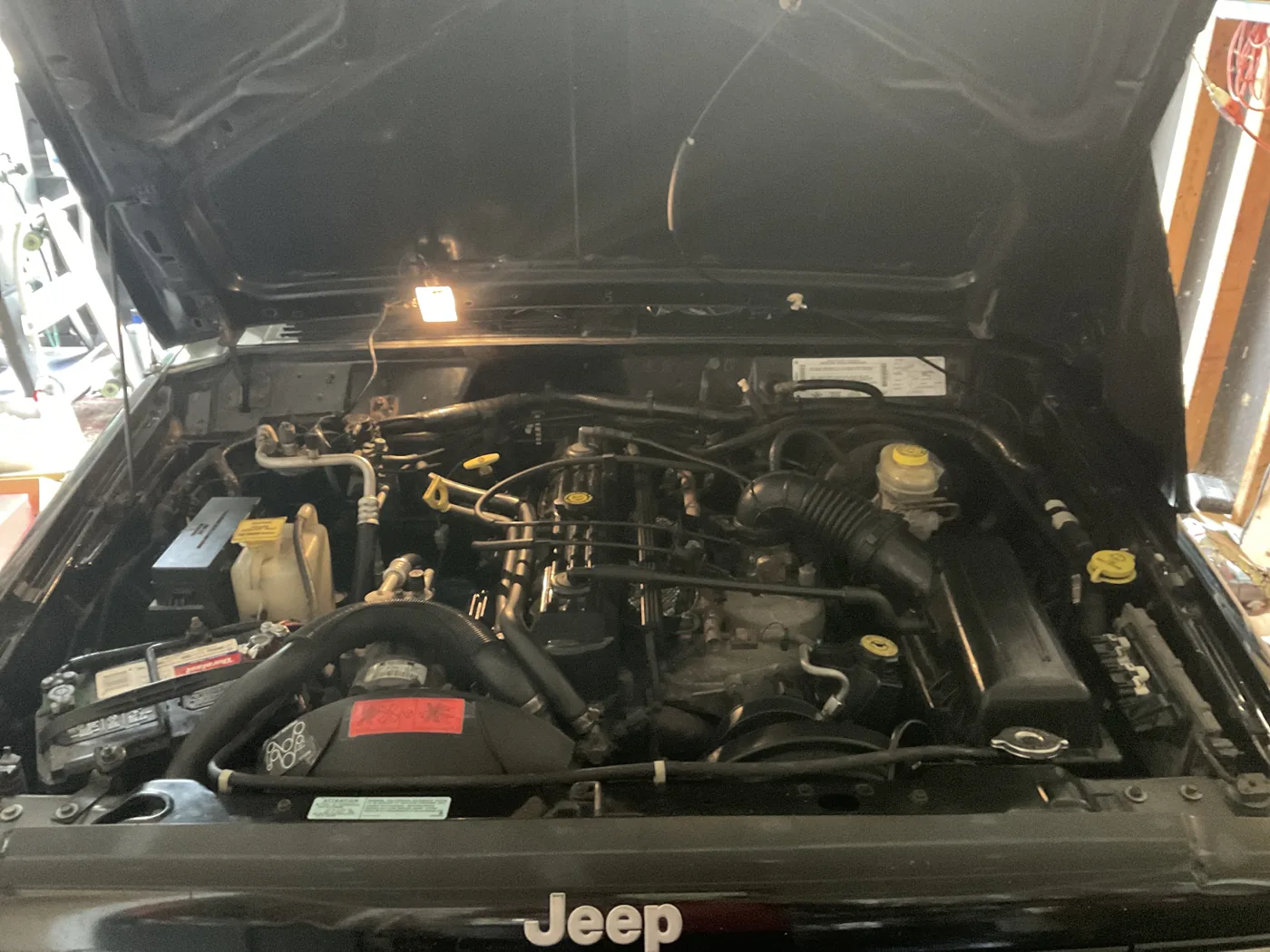

It's a cast-iron block-and-head inline-six with pushrod-actuated overhead valves (OHV, 12 valves) and a crankshaft riding on seven main bearings — hence its smoothness and durability. It's not a revver or a power champion: it makes its torque down low, exactly what you want for mud and towing.
Displacement is 3,959 cc (242 cubic inches). It shares DNA with the 2.5-liter four, which is essentially this engine minus two cylinders and with the same philosophy: simple, rugged and easy to fix anywhere.
Renix vs. High Output
There are two big families of the 4.0. The early ones (1987–1990) used the Renix (Renault-Bendix) engine management and made 173–177 hp. In 1991 came the High Output (HO) version: a new intake manifold, a head with larger ports and Chrysler multi-point injection. The result: 190 hp and 225 lb-ft, the figure that stuck with the engine until the end.
A detail every XJ owner knows: the HO head and the Renix manifold don't bolt together without adapting, because the ports don't line up. It's one of the classic traps when mixing parts across model years.
The 0331 head: the weak point
The 4.0 has a famous Achilles' heel: the 0331 casting cylinder heads (used mostly in 2000–2001, and some 1999) tend to crack, typically between the exhaust seat of cylinders 3 and 4 and the coolant passage. The symptom is losing coolant or overheating for no obvious reason.
The usual fix is to swap in a less troublesome casting (such as the 7120 or 0630) or repair it. It's a well-known issue with parts and a clear fix — it doesn't dent the engine's immortal reputation, but it's worth knowing when buying a late-series XJ.
Common quirks and building it up
Beyond the 0331, what tends to show up is the 'old but healthy engine' kind of thing: a weeping rear main seal, a sweating valve cover, a cracking exhaust manifold and the crank position sensor (CPS) that, when it fails, leaves the engine unable to restart when hot.
For those who want more, the classic route is the 4.6 stroker: combine the 258's crank with the 4.0 block to take it to ~4.6 liters and gain a wall of low-end torque. And if you've fitted big tires, remember to match the right axle ratio; without it, even the 4.0 feels gutless.
Specifications
| Displacement | 3,959 cc (242 cu in) |
|---|---|
| Configuration | Inline-6, OHV 12-valve, cast iron |
| Main bearings | 7 |
| Power | 173–177 hp (Renix) · 190 hp (HO) |
| Torque | 220–225 lb·ft (298–305 N·m) |
| Firing order | 1-5-3-6-2-4 |
| Years | 1987–2001 (in the XJ) |